
By Elizabeth Threlkeld
Fall is a great time to be outdoors enjoying the cooler temperatures. Bonfires with smores, stargazing, and fishing and hunting fill our fall calendar evenings, as well as yard clean up, pulling out dead plants that the first frost dispatched, and replacing them with fall crops. It’s also a great time for planting your new trees and shrubs!
The excess heat of summer requires an established root system for the larger plants to acquire enough water from the soil to survive. Likewise, the freezing temperatures makes the water in the soil inaccessible to the young plants. This makes spring and fall the ideal times to plant your larger flora. The cooler temperatures not only makes it more enjoyable for the “planter”, but also the “planted”.
Ponder it…
When planting a tree or shrub, begin with the end in mind. Consider these things before beginning:
- How tall and wide will this end up being?
- How large is the root structure going to be and will it interfere with underground pipes or utility lines, in-ground gardens, areas treated chemically, existing drainage, etc.
- Where will the shade land that this provides? Do I want those places/plants to be shaded?
- Does this plant produce juglone (an allelopathic compound produced by a plant to stunt the growth of another plant) and will that affect the surrounding plants?
- Does this plant drop seeds, fruit, and/or leaves and do I want that falling in this particular place?
- Is it a sturdy wood or a softer wood, prone to breaking?
- Does it spread by its root structure and therefore create a hedgerow or a thicket?
- How much sunlight and drainage does it require?
- Is this tree itself going to become food for wildlife such as deer/beavers?
- Will it grow into any overhead power/utility lines?
Wait!
Once you have determined WHAT kind of tree/bush you want to plant and WHERE you want to plant it, don’t forget this next critical step!
Call 811 from any phone, or go online, and put in a utility line locate request. It is required by law in every state to do so, even on privately owned property. Digging without contacting 811 can create a dangerous, life-threatening situation, result in personal fines from the utility companies and/or neighbors, or cause an outage to essential utility services for yourself and/or others. It is a free service, and is highly recommended before every digging project to protect yourself.
Dig it…
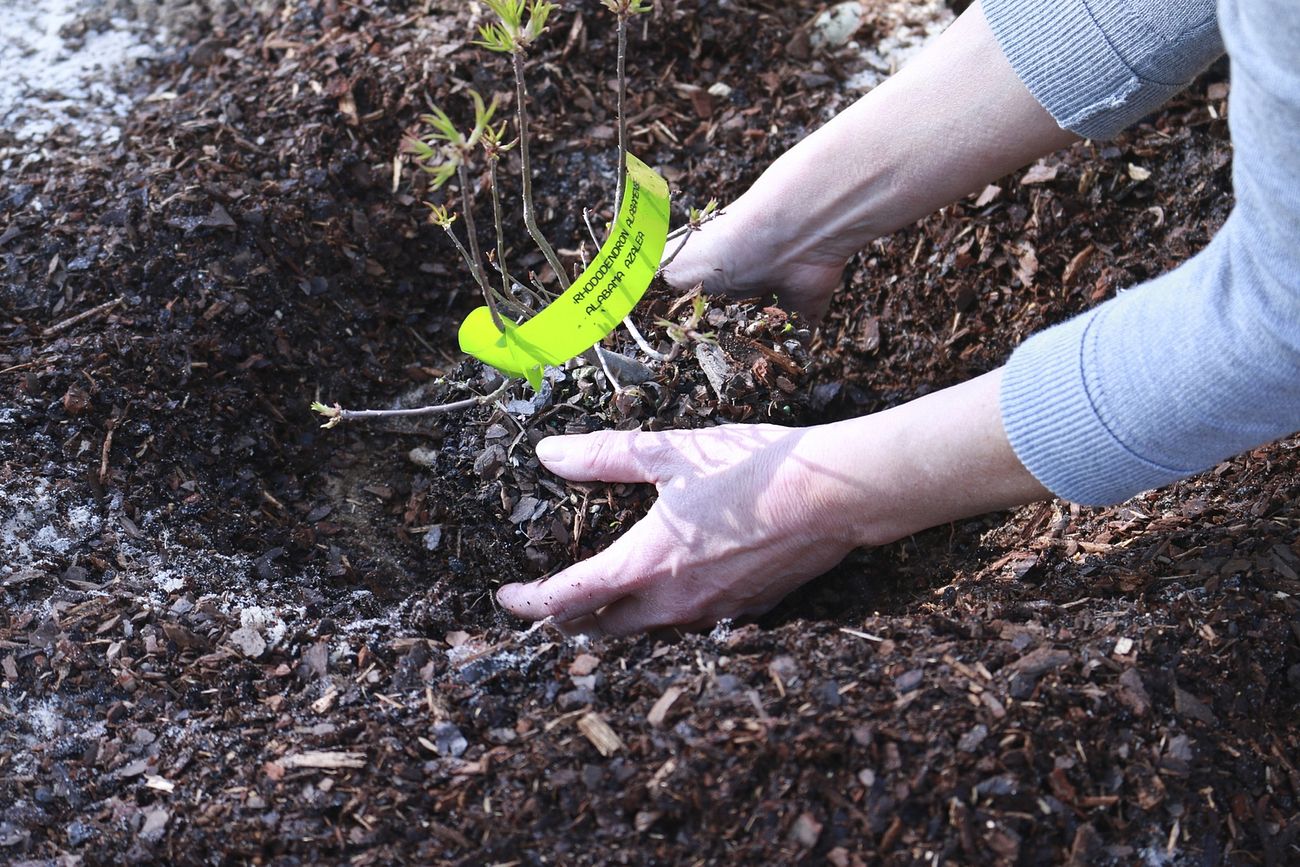
Ok, so you’re clear of all underground utilities. Now it’s time to dig. Dig the hole to the depth of your root ball (the roots plus all the dirt it is clinging to in your bucket/bag). Dig the hole 2½ – 3 times wider than the root ball. If you live in a drier climate, or if your soil is just very dry, fill the hole with water and let the earth absorb it all. Place the plant into the hole with the place where the roots meet the stem being level with the ground or just above the ground by about an inch or so. Backfill the hole with the original soil that was taken out of the hole.
Now isn’t the time to fertilize because it can actually discourage the roots from branching out into the surrounding soil, cause root burn on the tender new root shoots, and can also cause poor drainage if the matter is very different than what’s already there. If you feel you must do something, read about mulching below.
You will likely have excess dirt. I build a sturdy mound around my plant with it, being careful not to get too close to the trunk. This creates a water barrier that holds water until it can be absorbed directly on top of the root system. By the time the mound slowly fades into the yard, with the exception of a critter or a mower razing it, it’s usually enough time that my plant has become well established.
Mulch it…
Mulching is a great way to bump up the probability of success for your new plant baby. It will prevent water loss, especially if you don’t have enough dirt to fortify a mound, by preventing evaporation and competition from weeds. Cutting back on the weeds will also preserve nutrition for your plant. Mulching will also protect the vulnerable roots from the severe temperatures that may still plague the surface of the soil this time of year.
Before you rush out and buy mulch, you may have some just laying around your yard! You can use old wood chips or sawdust (one year old or older – new wood chips bind up nitrogen in your soil), leaf mold or mulch (fully or partially decomposed leaves – you know the kind you can pick up in ‘sheets’), compost, pine needles, bark, grass clippings, etc. Basically any organic material that hasn’t been sprayed with an herbicide (hay/straw can potentially be a no-no here) or other toxic chemicals. Pile mulch 2-4 inches high and the same width or a smidge bigger than your hole was.
Stake it…
To stake or not to stake? Staking’s main purpose is to stabilize the root ball from being jarred by the wind. You can use just about anything as a stake. Drive it into the ground about 1 – 1.5 ft, depending how big your plant is. You can use 1, 2, or 3 stakes so that they guard your plant from the winds that will be blowing. Place the stakes equidistant from each other, on the outside of the hole and use nylon hoses, flexible string, or something that has some give to it to loosely tie around the stake and the trunk. The tie should be slack at all times unless being blown into by the plant from the wind. Keep stakes in the ground for up to 1 year. If left too long, they can hinder growth and weaken the tree’s ability to protect itself against the winds.
Stakes should not generally be used to immobilize the trunk. The exception to that rule would be if you bought a tall, slender trunked tree that had been growing most of its life between other trees and hadn’t gotten a lot of exposure to winds. Especially if you were planting this type of tree out into an open, breezy space, you would want to semi-immobilize the trunk for a short time, gradually loosening the ties over time to allow it to bend and sway with the wind. When planting a tree like that, you will want to gradually expose it to the winds so that it can strengthen itself over time. I had a couple trees from a private nursery that grew their whole life situated down in a holler and I was planting them in high wind areas. I put mine on a 3 year regimine. 3 stakes, 3 years. Each year I took out a stake and loosened the remaining ties. They are stake-free now and doing great!
Water it…
Watering is essential for the success of a newly planted tree/shrub! Your plant should get 2-3 gallons of water/inch of trunk width at a rate of 2-3 times per week for at least the first year – I do this for two years just to be safe! You want the soil around your entire root ball to stay moist – not water logged – that first year. This will not only help the plant grow, but it will also keep the soil pliable enough for the roots to spread out and move through. Of course, rainwater is usually one of the best choices to water with, but any water is better than none! Since soil health is so much about the microbiome of what lives in it, if you really want to give your plant baby a boost, feed it the whey from your fermenting project! This is alive with yeasts and bacteria that will help break down nutrients for the roots of your plant to be able to absorb into its roots!
Wait for it…
The last step – Have patience! My very first gardening mentor, Jeannette, told me this when I was telling her about my slow-growing tree I had planted, “The first year it sleeps. The second year it creeps. The third year it leaps!”
Do it!
So, my Friends, every day is Earth Day! What will you plant this fall? I’m ROOTing for you!
~Elizabeth Threlkeld
Sunny Creek Trading Post Owner


Leave a Reply